
Summary:
There’s a version of pest control that’s perfectly manageable on your own — an ant trail near the kitchen, a spider in the basement. Then there’s a different category entirely. Birds roosting in your roofline, hornets building inside your wall, mice reproducing behind your insulation. These aren’t problems that a can of spray or a YouTube tutorial will fix. They require the right knowledge, the right equipment, and in some cases, a working understanding of federal law. If you’re dealing with one of the pests below, here’s what you actually need to know before you do anything else.
Bird Exterminator Services: When Birds Stop Being Visitors and Start Being a Problem
Most people don’t think of birds as pests until the damage is already done. A pair nesting in your soffit seems harmless enough — until you’re looking at droppings corroding your roofline, a blocked vent creating a fire risk, or a full colony that’s claimed your eaves as permanent real estate.
In Morris County, the proximity to the Great Swamp National Wildlife Refuge means bird activity is consistently elevated. Wooded lots in towns like Denville, Chatham, and Parsippany create ideal nesting conditions, and once birds establish a site, they return season after season. That’s the part most homeowners don’t anticipate — birds are creatures of habit, and passive deterrents like plastic owls or reflective tape rarely hold them off for long.
Why You Can't Just Remove a Bird Nest Yourself
Here’s something most homeowners don’t know until they’re already in trouble: the vast majority of bird species in the United States are federally protected under the Migratory Bird Treaty Act. Out of more than 800 bird species found in the U.S., only three — pigeons, European starlings, and house sparrows — are classified as pest birds not afforded those protections. Every other species requires a federal permit before you can legally disturb an active nest.
That’s not a technicality. It’s a real legal exposure that catches homeowners off guard every spring. If you’re not certain what species you’re dealing with, removing a nest yourself could put you on the wrong side of federal law — even if the birds are causing genuine damage to your property.
Beyond the legal complexity, there’s the health side. Bird droppings can carry more than 60 transmittable diseases and parasitic organisms. One of the more serious is histoplasmosis, a respiratory infection caused by fungus that grows in accumulated droppings. Cleaning up after an established bird colony without proper protective equipment isn’t just unpleasant — it’s a legitimate health risk. Birds also introduce secondary pests like mites, lice, ticks, and fleas into the home, which means a bird problem can quietly become a multi-pest problem before you realize what’s happening.
Professional bird control starts with accurate species identification, which determines what’s legally permissible. From there, we combine physical exclusion — netting, spike systems, wire deterrents — with sanitation and, where appropriate, behavioral alteration methods that condition birds to avoid the area without harming them. The goal isn’t just removal. It’s making sure they don’t come back. That’s where the exterior cleaning side of our work becomes relevant, too. Accumulated droppings, clogged gutters, and debris-filled eaves are attractants. Eliminating the pest and then cleaning the surfaces that drew them in is the only approach that holds long-term.
Hornet Removal: Why Waiting Makes This One Worse
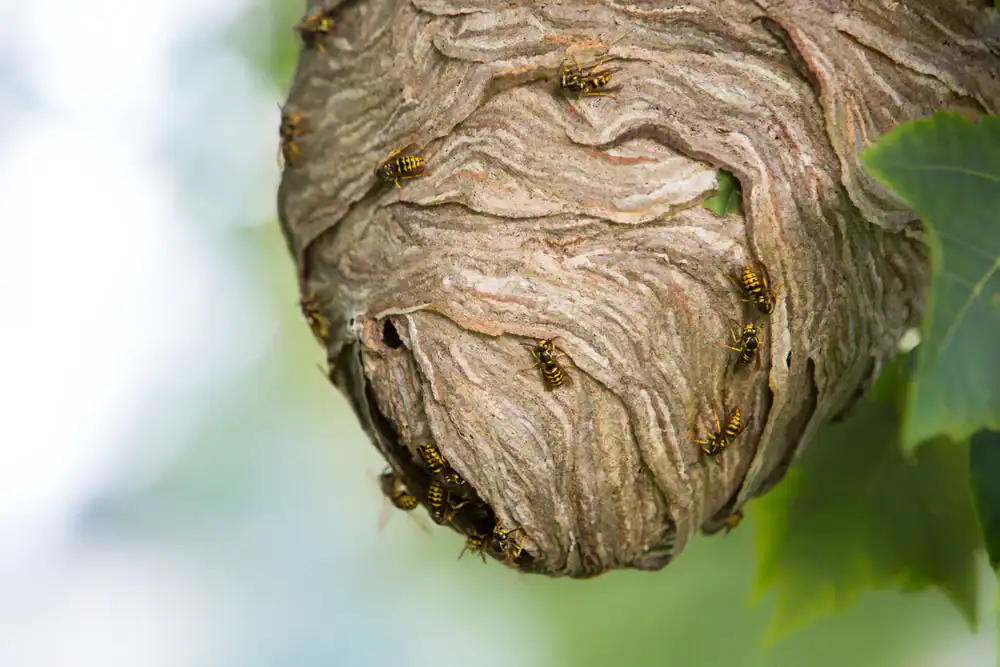
Hornets don’t give you a warning period. A colony that’s small and manageable in May can be thousands of workers strong by late summer, and the more established the nest, the more aggressively the colony defends it. Bald-faced hornets in particular — common in Morris County’s wooded neighborhoods — are known for their unprovoked aggression when they perceive a threat near the nest entrance.
The instinct to handle this yourself is understandable. Hardware stores sell aerosol sprays marketed exactly for this situation. The problem is that spraying visible hornets without treating the nest itself leaves the colony intact. The queen survives, workers rebuild, and you’re back to the same problem within days — except now the colony is on alert.
There’s also a real physical danger here that’s worth being direct about. Hornet stings can trigger severe allergic reactions, and when a colony is disturbed, they don’t sting once. We handle hornet removal with the right protective equipment, the right treatment applied directly to the nest, and the experience to do it at the right time of day when colony activity is lowest. For homeowners in Randolph, Roxbury, or any of the more heavily wooded parts of Morris County, this is not the pest to experiment with.
One more thing worth knowing: hornets frequently build inside wall voids, under eaves, or in attic spaces — locations that aren’t visible until you’re already dealing with an active infestation. If you’re hearing a low buzzing inside a wall or noticing unusual wasp traffic near a gap in your siding, that’s worth a professional inspection before it becomes an emergency.
Carpenter Bee Removal, Fly Exterminator Services, and Mice Removal: The Pests Morris County Homeowners Most Often Underestimate
Birds and hornets tend to get attention because they’re visible and immediate. But three other pest categories cause just as much long-term damage in Morris County homes — often because homeowners don’t recognize the severity until it’s well past the easy-fix stage.
Carpenter bees, flies, and mice each follow their own seasonal patterns, and each requires a different professional approach. What they share is this: by the time most people call for help, the problem has been developing for longer than they realize.
Carpenter Bee Removal: The Damage Is Deeper Than the Hole You Can See
Carpenter bees look like bumblebees, which is part of why people don’t take them seriously at first. But where bumblebees nest in the ground, carpenter bees bore into wood — decks, fascia boards, pergolas, wooden trim — to create nesting galleries that can extend six to ten inches into the material. What looks like a single round hole on the surface is often the entrance to a branching tunnel system that’s been expanded over multiple seasons.
In Morris County, where custom wooden decks and older homes with exposed wood trim are common, this matters. The structural damage accumulates quietly. And there’s a secondary problem: woodpeckers are attracted to the larvae inside those galleries, and they’ll tear into the wood to get to them. A carpenter bee infestation that goes untreated long enough often ends with woodpecker damage on top of it.
Spring is when carpenter bees are most active — you’ll see them hovering near wood surfaces, the males dive-bombing anything that moves near the nest entrance (they’re actually stingless, but the behavior is alarming). That’s the window to act. We apply the right product directly into the galleries to eliminate the larvae, then seal the entry points to prevent re-nesting. Painting or staining exposed wood is one of the most effective long-term deterrents, since carpenter bees strongly prefer bare, weathered wood. Leaving treated wood unfinished is essentially an open invitation.
Fly Exterminator and Mice Removal: Two Problems That Signal a Bigger One
A fly problem that persists despite cleaning usually points to a source issue — something decaying, something breeding, something that surface-level spraying won’t reach. Drain flies indicate organic buildup inside plumbing. Cluster flies in attic spaces are overwintering in the structure itself. Blow flies appearing indoors in significant numbers often mean there’s a dead animal somewhere in the wall or crawl space. Each scenario requires a different treatment approach, and none of them respond well to generic fly spray applied at the symptom rather than the source.
Mice are a similar story. Morris County’s wooded suburban neighborhoods — the kind you find throughout Boonton, Chester, Flanders, and East Hanover — back up against the exact habitat mice prefer. They start moving indoors in the fall as temperatures drop, and they don’t need much of an opening to do it. A gap the width of a dime is enough. Once inside, a single pair can produce dozens of offspring in a matter of months.
The reason mice removal belongs in the professional category isn’t just about trapping — it’s about exclusion. Placing a few snap traps addresses the mice you can see. It does nothing about the entry points that will bring in the next wave. We map the entire perimeter, identify every gap, crack, and utility penetration that’s serving as an entry point, seal them with appropriate materials, and then address the active population. Mice also carry real health risks — hantavirus, salmonella, and leptospirosis among them — and their droppings and urine contaminate insulation and wall cavities in ways that require proper cleanup, not just removal of the visible evidence.
When to Call a Professional Pest Exterminator in Morris County, NJ
The common thread across all seven of these pest categories is that the problem is almost always more developed than it appears on the surface. Birds have been nesting longer than you think. Carpenter bee galleries run deeper than the entry hole suggests. Mice have more access points than the one you found. Waiting — or trying a partial fix — typically means a larger job later.
If you’re dealing with any of these pests in Morris County, the right move is a professional inspection before anything else. You need someone who can accurately identify what you’re dealing with, assess the full scope of the problem, and give you a clear plan — not a generic treatment applied and forgotten.
We serve Morris County homeowners and property managers with same-day appointments available when you call before noon, a 100% satisfaction guarantee, and licensed, insured technicians who know this area. If the problem comes back, so do we — at no additional cost.