
Summary:
You didn’t do anything wrong. Bed bugs show up in spotless homes, five-star hotels, and packed commuter trains — and Morris County residents deal with them more than most people realize. Whether you woke up with unexplained bites, spotted something suspicious in the seams of your mattress, or just want to know what you’re looking at before you call anyone, this page gives you straight answers. We’ll walk through how to identify bed bugs, what treatment actually involves, what it costs in this area, and what to do when you need help fast.
Bed Bug Control: How to Know You're Actually Dealing With Bed Bugs
This is where most people get stuck. Bed bugs are small, fast, and almost never out in the open during the day. What you’re more likely to see first are the signs they leave behind — rust-colored stains on your sheets, tiny shed skins along the mattress seam, or a faint sweet, musty odor in the room.
The bugs themselves are real, but easy to miss. Adults are about the size of an apple seed, flat, and brownish-red. After feeding, they swell and darken. Eggs are nearly invisible — white, about 1mm long, and usually tucked into cracks, seams, or the gap between your mattress and box spring.
One thing worth knowing: bite marks can take up to 14 days to appear on some people. That delay makes it easy to assume the problem started more recently than it did.
Bed Bug vs. Bat Bug — A Distinction Morris County Homeowners Often Miss
Here’s something that doesn’t come up enough: bat bugs. If you live in or near one of the older homes in Morristown, Dover, or Boonton — the kind with plaster walls, original baseboards, and a history — there’s a real chance what you’re seeing isn’t a bed bug at all. Bat bugs look nearly identical to bed bugs under normal lighting. The main difference is microscopic: longer hairs on the thorax. Functionally, they behave the same way and hide in the same places.
The distinction matters because the treatment differs. Bat bugs come from bats roosting in your attic or wall voids. If you treat for bed bugs but miss the bat colony, the problem comes right back. A proper inspection accounts for both.
Other common misidentifications include carpet beetles, spider beetles, and booklice — all of which can be found in Morris County homes and all of which get mistaken for bed bugs at a glance. Carpet beetles, for instance, are similar in size but have a mottled pattern and don’t bite. Spider beetles are rounder and often found near food sources. Neither one requires the same treatment protocol as a true bed bug infestation.
The takeaway: don’t assume, and don’t treat blindly. A correct ID before any bug control work begins saves you time, money, and a second round of the same problem. If you’re not sure what you’re looking at, that’s exactly what an inspection is for.
Where Bed Bugs Hide in Morris County Homes
People assume bed bugs stay in the bed. They don’t. The bed is where they feed — but they live within about five to eight feet of where you sleep, in any crack or crevice they can find. That includes the gap between your baseboard and the floor, behind electrical outlet covers, inside picture frames, in the folds of curtains, and deep in the joints of upholstered furniture.
In older Morris County homes — and there are a lot of them, particularly in Morristown and Dover — the housing stock creates more hiding spots than newer construction does. Plaster walls crack. Baseboards separate. Older furniture holds more seams. That’s not a knock on these homes; it’s just a practical reality that affects how thorough an inspection needs to be.
Multi-family housing adds another layer. If you live in a townhome or condo community — common in Parsippany, Denville, and Rockaway — bed bugs can travel between units through shared walls, electrical conduits, and plumbing. Treating one unit without addressing adjacent ones is one of the most common reasons infestations come back. We work with HOA communities throughout Morris County specifically because of this, and we understand the coordination that kind of situation requires.
The point is: bed bugs are not a “just wash your sheets” problem. By the time you’re seeing signs, they’ve almost certainly spread beyond the mattress.
Bed Bug Heat Treatment: What Professional Treatment Actually Looks Like
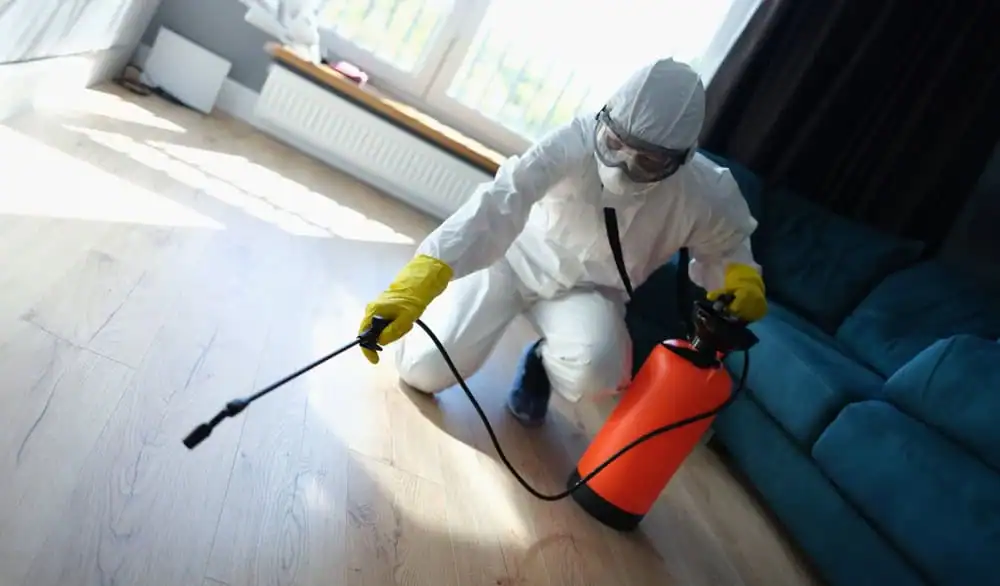
There are two main approaches we use — heat treatment and chemical treatment — and they’re not interchangeable. Heat treatment involves raising the temperature inside your home to between 135°F and 145°F, which kills bed bugs at every life stage: eggs, nymphs, and adults. It typically works in a single visit. Chemical treatment uses targeted insecticide applications and usually requires multiple sessions because it depends on bed bugs making contact with treated surfaces over time.
Neither approach is wrong, but heat treatment is generally more thorough when it comes to complete eradication in one pass. The right choice depends on the severity of the infestation, the layout of your home, and your timeline.
Why DIY Treatments Don't Work — And What That Costs You
The EPA is pretty direct about this: foggers and over-the-counter bug sprays have little to no effect on bed bugs. That’s not a sales pitch — it’s the reason so many Morris County homeowners end up calling us after spending $50 to $200 on hardware store products that didn’t work.
The problem is penetration. Bed bugs hide in places aerosol sprays can’t reach. A fogger fills the air in a room but doesn’t get into the seams of your mattress, behind your baseboard, or inside your box spring. Worse, it can scatter bugs further into the home — pushing them into rooms they hadn’t reached yet.
There’s also the resistance issue. Many bed bug populations have developed resistance to pyrethroids, the most common active ingredient in consumer pest products. Applying them repeatedly doesn’t increase effectiveness; it just delays proper treatment while the infestation grows.
A single female bed bug can lay up to five eggs a day and up to 500 in her lifetime. A minor infestation that might cost a few hundred dollars to treat professionally can become a whole-home problem within two to three months. The cost of waiting — financially and in terms of lost sleep — almost always exceeds the cost of calling sooner.
Same Day Service: What to Do When You Can't Wait a Week
Bed bugs are not a “schedule something for next Thursday” problem for most people. Once you know they’re there, waiting feels impossible — and practically speaking, every day you wait is another day the infestation can spread.
We offer same-day appointments when you call before noon. That’s not a marketing line; it’s an operational commitment. For Morris County homeowners who commute to New York City, manage a rental property, or are dealing with a situation that’s already disrupted their sleep, the ability to get help the same day matters. A lot.
If you’re a property manager dealing with a complaint from a tenant, same-day response also matters from a liability standpoint. Documented, prompt action protects you. Delayed response — or a DIY attempt that doesn’t hold — creates a paper trail you don’t want.
We’re based in Franklin, NJ, just off Route 23, which puts us within a reasonable drive of most Morris County communities. That proximity is part of why same-day service is realistic for this area. We know the roads, we know the towns, and we’re not dispatching from a regional hub three counties away.
Pest Inspection Cost and Pricing Transparency
One of the most common reasons people hesitate to call a pest control contractor is not knowing what it’s going to cost. So here’s a realistic range: professional bed bug treatment for a single room typically runs between $300 and $500 for chemical treatment. A full home can range from $1,500 to $5,000 depending on the size of the infestation and the method used. Heat treatment for a whole house generally runs higher — $4,000 to $7,000 — but often resolves the problem in a single visit rather than multiple sessions. A pest inspection typically costs $50 to $100, and in many cases that fee is applied toward treatment if you move forward.
We tell you the cost before we start. No surprises at billing, no vague estimates that shift once we’re in the door. If you want to know what you’re looking at before committing, that’s a reasonable thing to ask, and we’ll give you a straight answer.
Bed bugs are a solvable problem. They feel overwhelming when you’re in the middle of it — the disrupted sleep, the anxiety, the frustration of not knowing how bad it’s gotten — but with the right approach, they go away and stay gone. If you’re in Morris County or the surrounding area and you’re ready to deal with this, reach out to us. We’ll tell you what we’re seeing, what we’d recommend, and what it costs. No pressure, no runaround.