Summary:
If you’ve been putting off termite protection because it feels like an expense you don’t need yet, you’re not alone. Most Morris County homeowners think the same thing — right up until they find mud tubes along their foundation or a contractor tells them the floor joists need replacing.
This page is for the homeowner who’s weighing the cost of a protection plan against the risk of doing nothing. We’ll walk through what termite protection actually costs in this area, what repairs run when things go wrong, and how the two numbers compare. By the end, the decision gets a lot simpler.
Termite Prevention Cost: What You're Actually Paying For
Termite prevention isn’t a single service — it’s a category that includes inspections, soil treatments, bait systems, and annual monitoring programs. The cost varies depending on which approach makes sense for your home, but in Morris County the range for most homeowners falls between $400 and $1,000 per year for ongoing protection.
An initial liquid barrier treatment — where a licensed technician treats the soil around your foundation to block termite entry — typically runs $1,000 to $3,200 depending on your home’s perimeter. Bait station systems (like Sentricon) cost roughly $500 to $1,200 to install, with annual monitoring fees of $200 to $400 after that. Annual inspection-only programs start lower, sometimes around $175, though those don’t include treatment if activity is found.
The point isn’t to memorize every price tier. It’s to understand that prevention, spread across a year, costs less per month than most people assume — and far less than what happens when a colony goes undetected for too long.
How Long Does Termite Treatment Last — and When Does Your Home Become Vulnerable Again?
This is one of the most important questions Morris County homeowners don’t think to ask. If your home was treated during construction — which was standard practice for many developments in Denville, Parsippany, and surrounding towns — that original soil barrier has almost certainly broken down by now. Liquid termite barriers applied during new construction begin degrading after approximately five years. If your home is more than a decade old and has never been retreated, you’re likely unprotected.
Eastern Subterranean Termites, which are the dominant species throughout New Jersey, are patient. A colony can spend five or more years establishing itself and expanding before it causes damage visible enough to notice. That’s the part that catches people off guard — by the time you see a sign, the colony has usually been active for years.
In Morris County specifically, the risk isn’t theoretical. The USDA classifies New Jersey in Termite Infestation Probability Zone 2, which means moderate to heavy infestation potential. The county’s wooded character — think the lots around Chester, Chatham, and Rockaway — keeps termite food sources (dead wood, stumps, mulch) close to residential foundations year-round. Add in the moisture from the Rockaway River corridor and the county’s numerous streams and reservoirs, and you have conditions that subterranean termites actively seek out.
Retreatment timing matters. If it’s been more than five years since your home was last treated, or if you’ve never had it treated at all, scheduling an inspection isn’t a precaution — it’s overdue maintenance. The good news is that catching activity early, before structural damage sets in, keeps the cost of intervention dramatically lower than reacting to an established infestation.
Termite Warranty Cost: What Different Plans Actually Cover
Termite warranties get sold in ways that don’t always make their limitations obvious, so it’s worth understanding what you’re actually buying before you sign anything.
The two main types are retreat-only warranties and repair warranties. A retreat-only warranty means that if termites are found during the coverage period, we’ll come back and treat — but any structural repairs come out of your pocket. Repair warranties cover both retreatment and the cost of fixing damage caused by termites during the coverage period, which is a meaningfully different level of protection.
Retreat-only warranties are more common and less expensive, often starting around $495 per year. Repair warranties typically cost two to three times more, but some cover up to $250,000 in structural repair costs — which matters a great deal if a colony has been working on your floor joists or wall framing for several seasons.
The thing most homeowners don’t realize until it’s too late: standard homeowners insurance policies don’t cover termite damage. It’s treated as a preventable maintenance issue, not a sudden loss. That means if you discover significant structural damage, you’re absorbing that cost entirely on your own unless you have a repair warranty in place. Some policies have extremely narrow exceptions — like if a pipe leak created the moisture conditions that led to an infestation — but in practice, those exceptions rarely apply.
What we offer at Prestige Pest Unit & House Wash is backed by a 100% satisfaction guarantee. If you’re not satisfied after a service, we’ll retreat at no additional cost. That reflects the same principle: you shouldn’t have to wonder whether the job was done right.
Termite Protection Cost vs. What Repairs Actually Run
Here’s where the math gets concrete. The average homeowner who discovers termite damage pays around $3,000 to repair it. That’s the national average, and it reflects moderate damage — a section of flooring, some wall framing, maybe a door threshold. Structural damage to load-bearing beams or floor systems can push that number to $10,000 or more, and extensive cases go higher.
Now compare that to a protection plan running $700 per year — roughly the midpoint of what Morris County homeowners pay based on local cost data from towns like Morristown, Chatham, and Lincoln Park. At $700 per year, you’d hit the breakeven point against a single average repair event in just over four years. After that, every additional year of coverage is pure financial protection with nothing to recoup.
The math isn’t close. And it gets less close when you factor in that insurance covers none of it.
What Does Termite Damage Repair Actually Cost — and Who Pays for It?
Repair costs depend almost entirely on how long the colony had before someone noticed it. Cosmetic damage — surface-level wood, baseboards, window frames — runs on the lower end, typically $1,000 to $2,000. Damage to structural framing, subfloor systems, or load-bearing supports is where costs escalate quickly, often reaching $5,000 to $10,000 or beyond depending on the scope of the repair and the contractor rates in your area.
What makes this worse is the timeline. Because Eastern Subterranean Termites work from the inside out, you often don’t see the damage until it’s already significant. A colony that’s been active for three or four years in a wall cavity or crawl space can do substantial structural harm before a single visible sign appears above the surface.
In Morris County, older housing stock compounds the risk. Homes in Boonton, Dover, and parts of Morristown were built well before modern termite pre-treatment was standard. Many of these homes have never had a professional soil treatment applied. If you own one of them, the absence of visible damage isn’t evidence that you’re safe — it may just mean the colony hasn’t reached a detectable stage yet.
As for who pays: you do. Your homeowners insurance policy almost certainly excludes termite damage. The standard language classifies it as a maintenance issue — something the homeowner could have prevented — rather than a sudden, accidental loss. A few narrow exceptions exist, but they apply in rare circumstances and most claims are denied. The financial exposure falls entirely on the homeowner, which is exactly why the annual cost of a protection plan looks very different once you understand what you’re protecting against.
Why Exterior Cleaning Is Part of a Complete Termite Prevention Strategy
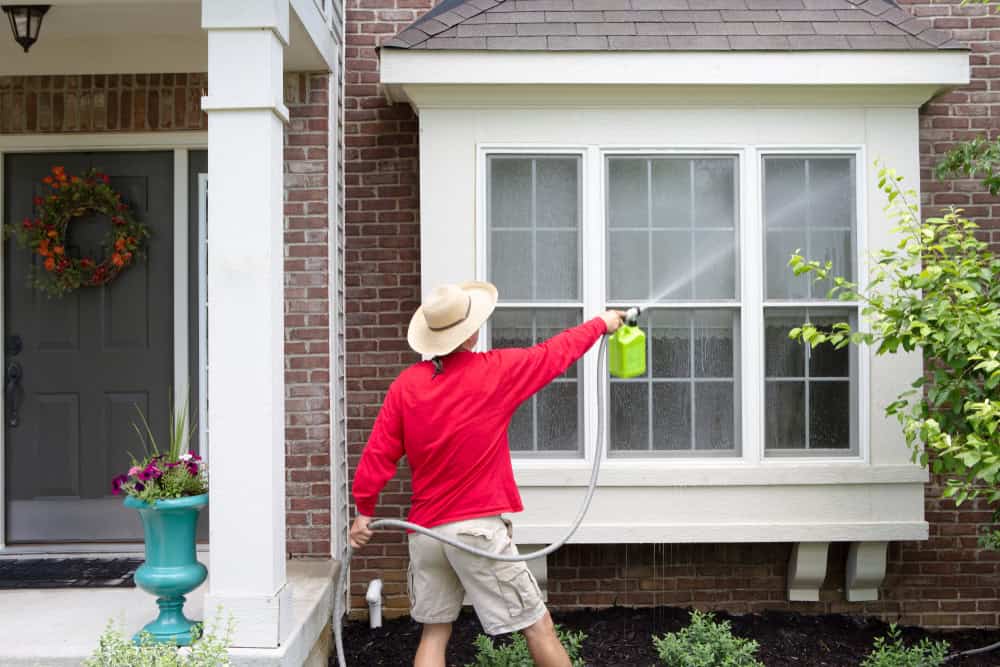
This is something most pest control companies don’t talk about, because most of them only do pest control. We do both — and there’s a practical reason the combination matters for termite prevention specifically.
Subterranean termites need moisture to survive and thrive. They seek out damp soil, wood with elevated moisture content, and structures where organic debris has created the conditions they prefer. When mold, mildew, algae, and decomposing organic material build up on your siding, under your eaves, or along your foundation line, it signals exactly the kind of moisture environment that termites are drawn toward. Professional exterior cleaning removes those conditions — not as a standalone termite treatment, but as a meaningful reduction in conducive conditions around your home.
For Morris County homeowners with wooded lots — especially in areas like Chester, Chatham, or the hillside communities around Denville — this matters more than it might for a home in a denser suburban neighborhood. Leaves, pine needles, and organic debris accumulate faster against foundations and along roof lines when you’re surrounded by mature trees. That buildup retains moisture. Moisture attracts termites.
When we clean a home’s exterior, we’re not just making it look better. We’re removing the biological signals that make a structure attractive to wood-destroying insects in the first place. Combined with a proper soil treatment or bait system, that’s a more complete layer of protection than either service provides on its own.
It’s also why we can offer something other pest control companies in Morris County can’t: a single provider who addresses both the pest and the conditions that attract it. Same-day scheduling, a 5.0 star rating across more than 158 reviews, and the kind of local knowledge that comes from actually working in this region — not dispatching from a regional hub two counties away.
Is Termite Protection Worth the Cost? Here's the Short Answer
Annual termite protection in Morris County runs roughly $400 to $1,000 per year. The average repair bill when termite damage is discovered runs around $3,000 — and structural damage can go well past that. Your homeowners insurance covers none of it. The math points in one direction.
The harder part isn’t the math. It’s acting before there’s a visible reason to. Termite colonies spend years establishing themselves quietly, and by the time you see evidence, the damage is already done. Prevention is the only stage where the cost is genuinely manageable.
If you’re in Morris County and you’re not sure whether your home is currently protected — or if it’s been years since anyone’s looked — that’s the right place to start. Reach out to Prestige Pest Unit & House Wash for a straightforward assessment, clear pricing, and same-day availability when you call before noon.